The Ultimate Guide to Choosing the Right Road Roller for Your Construction Project
Selecting the right compaction equipment is one of the most important decisions in any road or infrastructure project. A properly matched road roller ensures the subgrade, base course, and asphalt surface achieve the required density and uniformity, directly affecting the strength, durability, and overall quality of the finished work.
This road roller buying guide will walk you through the key considerations to help you determine how to choose a road roller that fits your specific job site, material type, and compaction depth requirements.
Why the Right Road Roller Matters
A road roller works by applying static weight, vibration, or impact to compress soil, asphalt, or gravel, eliminating air voids and increasing material density. Compaction is fundamental to structural longevity: insufficient density leads to settlement, cracking, premature surface failure, and higher future maintenance costs. Choosing the wrong type—too light for deep layers or too aggressive for thin asphalt—can cause under-compaction, over-compaction, or material damage. The key lies in matching the machine to the application.
Understanding the Main Types of Road Rollers
Different project conditions require different compaction methods. Here is a breakdown of the most common road roller types and their typical applications.
Single Drum Rollers (Soil Compactors)
Designed for deep-layer compaction of granular and semi-cohesive materials, single drum rollers feature a large drum at the front and pneumatic tires at the rear. With high centrifugal force and deep penetration capability, they are the go-to choice for compacting the subgrade and base course of highways, embankments, and large earthworks.
Tandem Rollers (Double Drum Rollers)
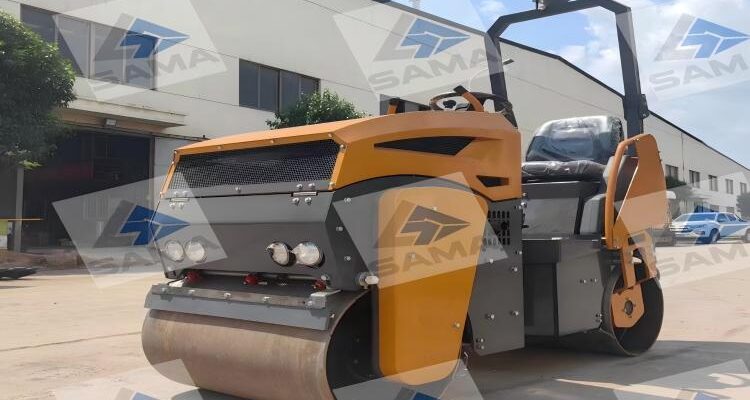
With two smooth drums providing uniform surface pressure, tandem rollers deliver high-quality, even finishes on asphalt surfaces. They are the preferred equipment for highway surface compaction, urban road projects, and asphalt patching where surface smoothness and uniformity are essential.
Pneumatic Tyre Rollers
Equipped with multiple rubber tires, pneumatic tyre rollers apply a kneading and sealing action, closing surface voids and producing a tight, uniform asphalt mat. This type is typically used as the final compaction stage to provide a dense, water-resistant surface for high-quality road finishes.
Padfoot (Sheepsfoot) Rollers
For cohesive, clay-rich soils, padfoot rollers feature protruding feet that penetrate and knead the material, achieving deep compaction in a limited number of passes. After compaction, a smooth drum roller is often used to level the surface.
Vibratory vs. Static Rollers
Vibratory rollers combine weight with high-frequency vibration to achieve deeper and faster compaction with fewer passes. Static rollers rely solely on their own weight, making them suitable for surface-level finishing on thin layers or final rolling. For most modern road construction, vibratory rollers are the standard due to their superior efficiency.
How to Choose a Road Roller by Weight and Size
One of the most critical factors in any road roller selection is matching the machine’s operating weight to the thickness of the layer being compacted.
Compact / Mini Rollers
With an operating weight of approximately 0.5 to 3 tons, these rollers are designed for small, confined spaces. They are ideal for sidewalks, driveway patchwork, landscaping, and narrow urban repairs where larger equipment cannot maneuver.
Medium Rollers
Weighing between 3 and 10 tons, medium rollers offer a balance between mobility and compaction force. They suit parking lots, residential developments, and municipal road projects requiring moderate layer thickness and reasonable output.
Heavy / Large Rollers
With operating weights of 10 tons or more, these machines are built for highways, expressways, airport runways, and major industrial infrastructure. For asphalt concrete pavements thicker than 100mm, large and medium-sized vibratory rollers with high amplitude (up to 1.0mm) and 6–10 tons are recommended to achieve full-depth density. For thinner layers below 60mm, a smaller 2–6 ton vibratory roller is preferable to prevent aggregate damage and surface wave formation.
What Size Road Roller Do I Need?
To answer this question, assess three key factors:
First, consider the type of material. Granular soils and rock fill respond well to heavy vibratory single drum rollers. Cohesive clays require padfoot rollers for deep penetration, while asphalt finishing calls for smooth tandem or pneumatic tyre rollers.
Second, evaluate project scale and site accessibility. Large, open highway stretches demand high-output heavy rollers to achieve efficient coverage. Confined urban or slope sites with limited turning radii necessitate smaller, more maneuverable machines.
Third, define required compaction depth. Deeper layers require heavier rollers with higher amplitude and centrifugal force to transfer compaction energy through the full lift thickness.
Selecting a Road Roller Manufacturer and Quality Factors
When evaluating equipment options, focus on build quality, availability of spare parts, and aftersales support. A well-constructed road roller with a reliable hydraulic system, durable drum components, and a fuel-efficient engine will deliver consistent results while minimizing downtime. Modern innovations such as GPS-enabled compaction meters and telematics systems allow operators to monitor density readings in real time, ensuring consistent quality across the entire construction site.
Summary: A Practical Road Roller Buying Guide
To simplify your decision, here is a quick reference table matching project conditions to recommended road roller types:
| Project Condition | Recommended Roller Type | Typical Weight Range |
| Highway subgrade / base layer | Single drum vibratory roller | 10+ tons |
| Asphalt surface course | Tandem vibratory roller | 6–12 tons |
| Final sealing / finishing | Pneumatic tyre roller | 10–25 tons |
| Clay / cohesive soil fill | Padfoot (sheepsfoot) roller | 8–20 tons |
| Sidewalk / driveway / patching | Compact / mini roller | 0.5–3 tons |
Choosing the best road roller for construction is not just about price—it is about matching the machine’s capabilities to the material, layer thickness, and job site conditions. A well-informed selection ensures efficient compaction, extends the service life of the pavement, and reduces long-term maintenance costs. Use this guide as your reference and always consult the technical specifications of any road flattener machine before making a purchase decision.
Have questions about which roller fits your project? Contact us today for expert advice and tailored recommendations.