How to Choose an Air Compressor: A Comprehensive Guide for Corporate Procurement
In the fields of industrial manufacturing, automotive repair, painting operations, and construction, air compressors have become indispensable pieces of equipment. Whether for a large-scale factory or a small repair shop, selecting the right air compressor not only boosts operational efficiency but also effectively reduces energy and maintenance costs.
What is the Air Compressor?
An air compressor is a mechanical device designed to compress and store air; by increasing air pressure, it serves as a power source for various types of industrial equipment.
Air compressors are widely used in:
- Automotive repair and painting
- Industrial production lines
- CNC machining equipment
- Construction
- Medical equipment
- The food packaging industry
- Woodworking machinery
- Tire inflation equipment
Modern enterprises are placing increasing emphasis on the stability of their compressed air systems, as this directly impacts production efficiency and operational costs.
Four Core Requirements to Clarify Before Selecting an Air Compressor
I. Air Consumption (CFM)
CFM (Cubic Feet per Minute) represents the volume of air supplied per minute and is one of the most critical metrics when selecting an air compressor.
If the air supply is insufficient, it can lead to:
- Uneven paint application
- Insufficient power for pneumatic tools
- Frequent equipment shutdowns
- Decreased work efficiency
It is recommended that businesses calculate the total air consumption of all pneumatic equipment and then add an additional buffer of 20%–30%.
II. Operating Pressure (PSI)
Different types of equipment have varying pressure requirements, for example:
| Application Scenario | Recommended PSI |
| Tire Inflation | 90-120PSI |
| Painting Equipment | 100–120 PSI |
| Industrial Production | 125–175 PSI |
| Heavy Machinery | 175 PSI and above |
When making a selection, ensure that the air compressor’s rated pressure exceeds the requirements of the equipment it will power.
III. Operating Environment
The specific work environment dictates the appropriate type of equipment.
- Indoor Workshops:
Silent-type air compressors
Electric screw compressors
Energy-efficient variable frequency models
- Outdoor Construction Sites:
Diesel-powered compressors
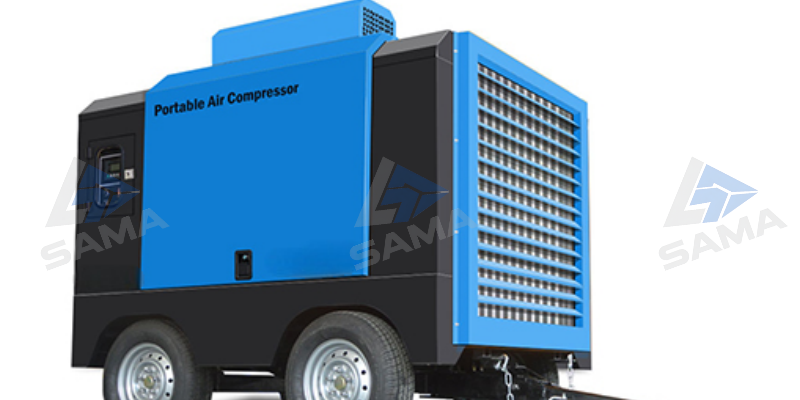
Portable/Mobile air compressors
High-durability industrial-grade models
Particularly at construction sites lacking a stable power supply, diesel-powered compressors offer greater flexibility and continuous operational capability.
IV. Operating Duration
If the equipment is required to run continuously for more than 8 hours per day, the following are recommended:
- Screw-type air compressors
- Industrial-grade heavy-duty models
- Units equipped with automatic cooling systems
For intermittent use scenarios, however, lower-cost piston-type air compressors may be a viable option.
The Importance of Energy Efficiency in Air Compressors
Many enterprises focus solely on equipment purchase prices during procurement, while overlooking long-term operating costs.
In reality, over the entire lifecycle of an air compressor:
- Approximately 70% of the total cost is attributed to electricity consumption.
- Only 10% to 15% stems from the initial purchase price.
Consequently, energy-efficient air compressors can help enterprises significantly reduce their long-term expenditures.
It is recommended to select models featuring:
- Variable Frequency Drive (VFD) technology
- High-efficiency motors
- Intelligent control systems
- Automatic start-stop functionality
These technologies effectively minimize energy waste.
Conclusion
Selecting the right air compressor is not merely the act of purchasing a piece of equipment; rather, it represents a long-term investment in the enterprise’s efficiency, operational costs, and future growth.