
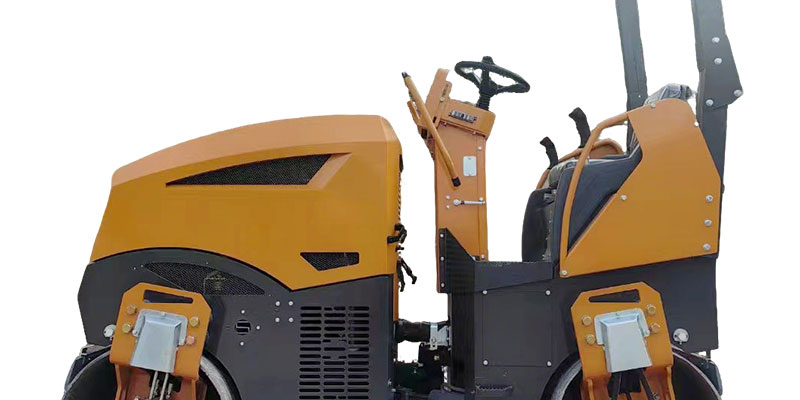
How to Achieve Perfect Asphalt Compaction with a Double Drum Roller: Tips & Best Practices
Proper asphalt compaction is one of the most critical steps in any paving project. Even with a high-quality asphalt mix and precise placement, poor compaction can lead to premature cracking, rutting, moisture intrusion, and costly repairs. When done right, the pavement achieves the density, durability, and smoothness required to perform for years.
A double drum vibratory roller—with two steel drums that both vibrate—is the industry’s go-to equipment for this task. Unlike single drum models, double drum rollers apply equal compaction force from both drums, making them perfect for achieving an even finish on asphalt surfaces. This guide covers essential tips and best practices for operating a double drum roller to achieve perfect asphalt compaction.
Prepare Your Roller Before Starting
Before compaction begins, proper roller preparation prevents costly surface defects:
- Clean drums thoroughly – Dirty or poorly maintained drums can cause asphalt pickup, tearing, and surface blemishes.
- Fill the water tank and check spray nozzles – The water spray system prevents hot mix from sticking to the drums, which is essential for a smooth finish. Inspect and clean spray nozzles and filters daily, and check water levels and pumps.
- Check all fluids – Ensure engine oil, hydraulic fluid, and fuel levels are adequate.
Understand the Three Compaction Phases
Asphalt compaction is typically performed in three distinct phases. Matching the right technique to each phase ensures uniform density without damaging the surface:
| Phase | Purpose | Typical Action |
| Breakdown Rolling | Achieves initial density, locks aggregate in place | First pass behind paver with vibration on; most density gain occurs here |
| Intermediate Rolling | Continues compaction before mix cools | Vibration may continue; pneumatic tire rollers add kneading action |
| Finish Rolling | Removes roller marks, smooths final surface | Vibration off or low amplitude; static passes to achieve smoothness |
A typical compaction train consists of: screed → breakdown roller (most often vibratory double drum) → intermediate roller (sometimes pneumatic tire for kneading action) → finish roller (static steel wheel for smoothest surface). Properly executed, these three phases deliver the target air-void content of 3% to 8% required for long-lasting pavement performance.
Master the First Pass Technique
The first pass with a vibratory double drum compactor is the most crucial step in achieving target asphalt density. The mix is hottest at this point, and aggregate particles are most easily rearranged into closer orientation.
Best practices for the first pass:
- Roll toward the paver with vibration on to achieve the greatest density gains.
- If the edge is supported by existing pavement, slightly overlap the cold joint by 3 to 4 inches (75–100 mm).
- If the edge is unsupported, stay 6 to 8 inches (150–200 mm) away from the edge on the first pass to reduce lateral shoving of the mat.
- Stop in a slight arc rather than perpendicular to the edge. This technique, known as “arcing,” prevents bumps and allows drum depressions to be rolled out on the next pass.
Control Compaction Temperature
Temperature is the single most important variable in asphalt compaction. The mix must be compacted while it is still hot enough to allow aggregate movement. Several factors affect cooling rates: air temperature, wind speed, base temperature, cloud cover, and layer thickness.
Temperature guidelines:
- Begin breakdown rolling as close behind the paver as possible – Do not wait too long, as the mix stiffens rapidly as it cools.
- Breakdown rolling should occur at temperatures above 290°F (mid-depth of the mat behind the screed). When breakdown rolling begins below 290°F, the risk of not achieving sufficient compaction is greatly increased.
- Monitor mat temperature consistently across the entire pass.
- Complete breakdown and intermediate rolling before the mix cools – Once the asphalt stiffens, achieving target density becomes nearly impossible without damaging the surface. In field specifications, breakdown and intermediate rolling are generally carried out at temperatures not less than 275°F (135°C) and 239°F (115°C) respectively; final rolling should be completed before the temperature falls below 194°F (90°C).
Maintain Steady Speed and Consistent Rolling Patterns
Roller speed directly affects density. The faster the roller moves, the less compactive effort is applied per pass. Changing roller speed merely causes variations in density—”slow and steady” is the key.
Speed guidelines:
- Maintain a steady speed of 2–3 mph (3–5 km/h) for vibratory rollers during breakdown rolling. For intermediate rolling, speed can increase to 2.5–3.5 mph; for finish rolling, 3–5 mph is typical for static steel wheel rollers.
- Coordinate speed with paver speed – If the paver pulls away from the rollers and rollers increase speed to catch up, density will be lower even with the same number of passes.
- Use a planned rolling pattern and overlap each pass by 6–8 inches (150–200 mm) to ensure even compaction across the entire mat. Random or inconsistent rolling patterns can lead to uneven density and visible surface defects.
- Stagger reversal points rather than stopping at the same transverse point with each pass to prevent shoving of the mix.
- Never stop or sit on hot asphalt – Allowing the roller to settle into a stationary position on the fresh mat creates indentations that are impossible to roll out once cooled.
Use Vibration Correctly
Vibration is a powerful tool, but incorrect vibration settings can cause aggregate displacement, surface tearing, or over-compaction. Double drum rollers typically operate in three modes: both drums vibrating, one drum vibrating and one static, or static only.
Vibration best practices:
- Match amplitude to layer thickness – For thick layers, use higher amplitude (0.7–1.0 mm) with lower frequency. For thin layers or finishing work, use lower amplitude (0.3–0.4 mm) with higher frequency to avoid over-compaction.
- Turn off vibration before stopping or changing direction to prevent surface scuffing.
- Use maximum frequency settings (typically above 2,000 VPM) for most applications to achieve more compaction from a given roller.
- Avoid over-compaction – More rolling is not always better. Over-compaction can crush aggregate, push asphalt binder to the surface, and create a slick or unstable finish. Signs of over-compaction include shoving or rippling in the mat, visible aggregate breakdown, and loss of surface texture.
Watch for Common Mistakes
Experienced operators know that avoiding errors is just as important as executing techniques correctly:
| Common Mistake | Consequence |
| Turning sharply on hot asphalt | Scuffing and surface tearing |
| Over-compacting the mat | Aggregate crushing, binder pushed to surface, slick finish |
| Neglecting drum cleaning | Asphalt pickup, tearing, surface blemishes |
| Inconsistent roller patterns | Uneven density across mat width; visible surface defects |
| Rolling outside temperature window | Failure to achieve target density; costly rework |
| Not using water spray system | Asphalt sticking to drums, damaging the mat |
Final Thoughts
Perfect asphalt compaction with a double drum roller requires attention to temperature, speed, vibration settings, and rolling patterns. A double drum roller is best used for asphalt paving projects and granular soil compaction, where you need an even, smooth finish on flat surfaces. When learning how to compact asphalt with a roller, remember these core principles: begin breakdown rolling as soon as the paver lays down the mat; maintain consistent speed and overlap across all passes; use the correct amplitude for your layer thickness; complete all compaction before the mix cools below workable temperature; and always keep your drums clean and water spray functioning. By following these best practices for a road roller, you will achieve proper density, a smooth finish, and pavement that stands up to years of traffic with minimal maintenance.