
The Ultimate Road Roller Weight Guide: How Many Tons Do You Really Need?
Selecting the right road roller for construction projects is one of the most critical decisions for achieving proper compaction. Too light, and the base remains loose—requiring extra passes and risking structural failure. Too heavy, and you risk over-compaction, aggregate crushing, or damage to underlying layers and nearby structures. This road roller weight guide walks through exactly how many tons you really need based on project type, material, and layer thickness.
Why Road Roller Weight Matters
A road roller’s weight directly determines compaction depth, efficiency, and final surface quality. Heavier road flattener machines deliver deeper, stronger compaction in fewer passes. However, matching weight to the specific job prevents problems such as shear failure on thin layers or wave formation on asphalt surfaces.
When asking “what size roller do I need,” the answer depends on three factors: project scale, material type, and layer thickness.
Road Roller Weight Categories: Light, Medium, and Heavy
Road rollers fall into three main categories based on operating weight:
| Category | Weight Range | Best For |
| Small / Light | 1–3 tons | Sidewalks, residential driveways, landscaping, patching, tight urban spaces |
| Medium | 3–10 tons | Parking lots, city streets, secondary roads, commercial sites |
| Large / Heavy | 10 tons and above | Highways, expressways, airports, dam foundations, industrial infrastructure |
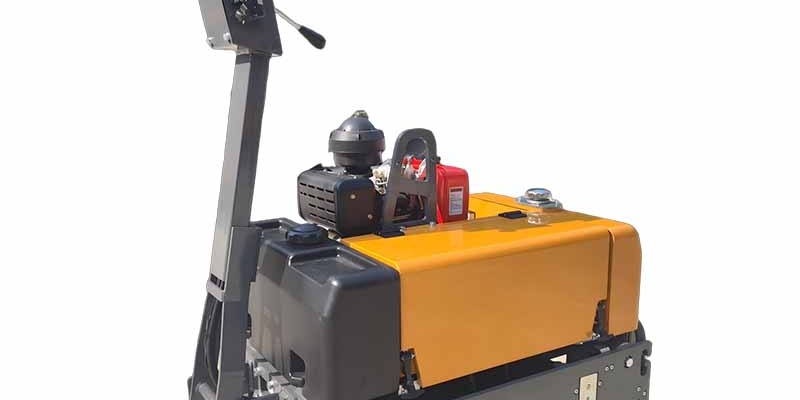
Light rollers (1–3 tons) are highly maneuverable in confined areas, easily transportable on small trailers, and optimized for thin-layer compaction where larger machines might damage curbs or surrounding structures. These are ideal for small road roller for construction tasks.
Medium rollers (3–10 tons) offer the perfect balance between compaction power and mobility. A 7–8 ton vibratory roller is often the most versatile choice, capable of handling both sub-base soil and asphalt top coats.
Heavy rollers (10 tons and above) deliver massive centrifugal force for deep-layer compaction on thick lifts of rock fill, heavy clay, or hot mix asphalt.
How Many Tons for Asphalt Compaction
For asphalt compaction, layer thickness is the primary factor determining the required roller weight. A road construction roller for asphalt must match the paving depth precisely:
| Asphalt Layer Thickness | Recommended Roller Weight | Amplitude Setting |
| Thin (< 60 mm) | 2–6 tons | 0.35–0.60 mm (low amplitude) |
| Medium (60–100 mm) | 6–10 tons | Moderate amplitude |
| Thick (> 100 mm) | 6–10 tons (large or medium-sized vibratory) | High amplitude (up to 1.0 mm) |
For thin paving layers less than 60mm thick, a small 2–6 ton vibratory roller with an amplitude of 0.35–0.60mm is best to avoid material accumulation, wavering, and aggregate damage. For thick layers exceeding 100mm, use large to medium-sized vibratory rollers with high amplitude (up to 1.0mm). The goal of asphalt compaction is a smooth, dense surface—excess weight can cause shoving or cracking on thin lifts.
Weight for Soil and Subgrade Compaction
Soil compaction prioritizes deep foundational stability over surface smoothness. Cohesive materials like clay require high amplitude and significant weight to overcome internal friction. For heavy earthwork and subgrade preparation, highway specifications often require steel wheel rollers weighing at least 10 tons to achieve proper density. For granular and gravel layers, moderate tonnage combined with high-frequency vibration is most effective, settling the aggregate without crushing the stones.
Choosing a Road Roller by Project Type
When choosing road roller by weight, match the machine to the project scope:
| Project Type | Recommended Weight Range |
| Sidewalks, garden paths, patch repairs | 1–3 tons |
| Residential driveways | 1–3 tons (or 2–4 tons for larger driveways) |
| Parking lots, commercial sites | 4–10 tons |
| City streets, secondary roads | 6–10 tons |
| Highways and expressways | 12 tons and above |
| Airports, heavy infrastructure | 15–20+ tons |
A 1–3 ton road construction roller works well for driveways, sidewalks, and tight urban sites where maneuverability matters most. For parking lots and city streets, 4–10 ton rollers provide the necessary compaction power without oversizing. Highways and large infrastructure demand 12 tons and above to ensure deep, uniform compaction that meets rigorous engineering standards.
Common Selection Mistakes to Avoid
Many contractors make three critical errors when selecting road roller weight:
- Ignoring vibration specifications – Two 10-ton rollers can have vastly different compaction outputs. Always check frequency (Hz) and amplitude (mm) alongside static weight.
- Overlooking site constraints – A 20-ton machine is useless if the site entrance or access bridge has a weight limit.
- Undersizing to save budget – Buying a smaller machine to save upfront costs often backfires through increased labor hours and excessive fuel consumption as the machine struggles to reach required density.
Final Thoughts
So, how heavy should your road roller be? For small projects like driveways and sidewalks, choose 1–3 tons. For parking lots and urban roads, select 4–10 tons. For highways, airports, and large infrastructure, go with 12 tons and above. Match your asphalt roller weight to layer thickness: thin layers under 60mm need 2–6 tons; thick layers above 100mm require 6–10 tons with high amplitude. For soil and subgrade work, heavier is generally better for deep foundation stability. Use this guide to match your road roller selection to the specific demands of your job site, and you will achieve optimal compaction, longer pavement life, and lower project costs.